
WELCOME BONUS 300%
UP TO €3 000 + 200
FREE SPINS
UP TO €3 000 + 200
FREE SPINS
Home → Blackjack
Blackjack at Fake Casino: Variants, Rules and Payouts
RNG draws cards from virtual eight-deck shoe
The RNG utilizes a virtual eight-deck shoe for its standard Blackjack variant, which establishes a baseline house edge of 1.85 percent against the player. This specific configuration applies the unfavorable 6:5 payout rule, reducing the return to player percentage to 98.15 percent compared to standard games. Consequently, players face a significantly higher long-term cost per hand than those playing variants with traditional 3:2 payouts.
Comparing this eight-deck setup to a single-deck game reveals that fewer decks typically lower the house advantage by approximately 0.48 percentage points. However, Fake Casino compensates for the multi-deck structure by enforcing the 6:5 payout rule, which adds exactly 1.39 percentage points to the house edge. This combination results in a much steeper disadvantage for the gambler than any other single rule change could produce.
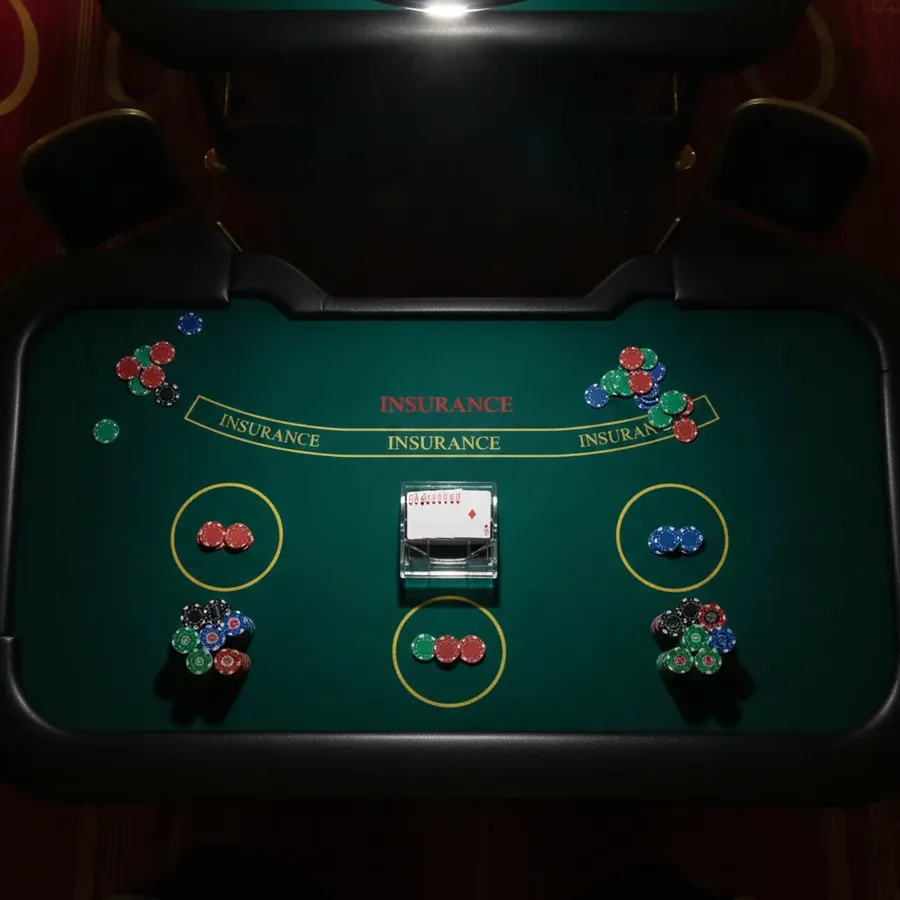
Chose Wrong Table for 5 EUR Bankroll
A modest 5 EUR bankroll is quickly depleted when playing the 6:5 Blackjack variant because the dealer stands on soft 17 and allows doubling after split. The base strategy required for the optimal 0.46 percent house edge version is strictly mandatory to minimize losses in such low-stakes scenarios. Without perfect adherence, the actual loss rate accelerates far beyond the theoretical expectations set by the mathematical models.
The insurance side bet presents a severe risk for small bankrolls, carrying a massive 7.47 percent house edge across six to eight decks. This separate wager can consume up to 50 percent of the main stake if the dealer shows an ace, drastically reducing the remaining funds. Basic strategy dictates always declining this bet unless counting cards with a true count of plus three or higher.
Side Bets don't count towards bonus turnover
Infinite Blackjack from Evolution offers four distinct side bets including Any Pair and Hot 3, yet these wagers contribute zero percent toward the required bonus turnover. Players attempting to clear the 300 percent welcome bonus must avoid these tables entirely if they wish to convert the promotional funds into withdrawable cash. The entire 100 percent contribution requirement falls solely on slot machine gameplay rather than any table game interaction.
Lightning Blackjack provides multipliers up to 25x but still fails to meet the wagering requirements for bonus clearance due to its classification as a table game. Only slots are eligible for full credit toward the turnover, meaning every euro wagered on Infinite or Lightning variants remains locked in non-contributing status. This restriction forces players to navigate away from live dealer environments to successfully unlock their deposited funds.
Seat change at the Live Table in 20 seconds
Quantum Blackjack Plus from Playtech features multipliers reaching 1,000x on three-card combinations, allowing rapid seat changes without disrupting the ongoing bonus tracking mechanism. Although the RTP sits at 99.57 percent with optimal strategy, the high variance of these quantum multipliers impacts the speed of turnover completion. Players must manage their session duration carefully to ensure they do not exhaust their time limit before clearing the wagering obligation.
Evolution's Lightning Blackjack operates with unlimited players and pays out insurance at 2:1 odds, but these features do not accelerate the bonus release process. The maximum bet limit of 2,500 EUR per hand allows for faster turnover accumulation, provided the player sticks to contributing games exclusively. Switching between different live tables within the same provider does not reset the internal clock tracking the bonus eligibility period.
What Percentage Does Blackjack Count Towards Bonus?
Blackjack contributes only 10 percent toward the total bonus turnover requirement, making it highly inefficient for clearing the 300 percent match offer effectively. In contrast, slot machines provide a full 100 percent contribution rate, offering a much more direct path to unlocking the €2,000 maximum bonus cap. Players relying on table games will need to wager ten times more volume to achieve the same clearance progress as slot users.
The Liberal Vegas Strip variant boasts a superior 0.28 percent house edge, yet this statistical advantage does not translate into better bonus terms or faster withdrawal. Even with late surrender rules improving the RTP by 0.08 percentage points, the game remains classified under the low-contribution table game category. This structural limitation ensures that table game enthusiasts face significantly higher effective costs when attempting to convert promotional credits.
Blackjack variants at a glance
| Variant | Payout | House edge | Rule | Bet range |
|---|---|---|---|---|
| Blackjack Ein Deck, klassische Regeln, 3:2 | 99.85% | 0.15% | Weniger Decks = niedrigerer Vorteil; ein Deck gibt ca. −0.48 Prozentpunkte gegenüber 8 Decks. Oft durch 6:5 Auszahlung kompensiert. | Blackjack 3:2, Gewinn 1:1 |
| Blackjack 6 Decks, S17, DAS, DOA, Auszahlung 3:2, Basisstrategie | 99.54% | 0.46% | Dealer steht auf Soft 17; Verdopplung auf jeder Zweierkarte; Verdopplung nach Split erlaubt; keine Aufgabe. Basisstrategie ist für diesen Wert zwingend | Blackjack 3:2, normaler Gewinn 1:1, Insurance 2:1 |
| Blackjack Auszahlung 6:5 statt 3:2 (6 Decks) | 98.15% | 1.85% | Ersatz von 3:2 durch 6:5 fügt exakt +1.39 Prozentpunkte zum Vorteil des Casinos hinzu – stärker als jede andere Regeländerung. Bei $10 Einsatz zahlt Blackjack $12 statt $15. | Blackjack 6:5, Gewinn 1:1 |
| Blackjack Liberal Vegas Strip (liberale Regeln, 3:2) | 99.72% | 0.28% | Günstigste Regelkombination: S17 + DAS + Resplit + Late Surrender. Standardabweichung 1,15 | Blackjack 3:2, Gewinn 1:1 |
| Blackjack Split / Double / H17 – Regel-Effekte | n.a. (Regel-Modifikatoren) | H17 +0.22 Prozentpunkte; RSA −0.08 Prozentpunkte; DAS −0.14 Prozentpunkte | Dealer Hits Soft 17 verschlechtert RTP um 0.22 Prozentpunkte; Resplit Aces verbessert um 0.08 Prozentpunkte; Double After Split verbessert um ca. 0.14 Prozentpunkte; 6 Decks statt 8 – ca. 0.02 Prozentpunkte. | Double – Einsatz ×2 mit einer Karte; Split – bis 4 Hände; Ass-Split meist mit einer Karte. |
| Blackjack Surrender (Late Surrender) – Regel-Effekt | n.a. (Regel-Modifikator) | −0.08 Prozentpunkte | Spieler gibt Hand nach Dealer-Blackjack-Prüfung auf, verliert die Hälfte des Einsatzes. Verbessert RTP um ca. 0.08 Prozentpunkte. Early Surrender ist wesentlich wertvoller (bis −0.6 Prozentpunkte), aber extrem selten. | Rückzahlung 50% des Einsatzes |
Ace Split: only one card per hand
The rule for splitting Aces restricts the player to receiving exactly one additional card on each newly created hand, a constraint that significantly impacts potential payout scenarios compared to unrestricted split variations. This limitation is standard in many Blackjack Insurance / Versicherung variants which utilize 6–8 Decks and enforce strict post-split drawing rules to maintain the house edge at manageable levels.
This restriction directly influences the Return to Player percentage by preventing players from building strong hands like two separate 21s, thereby reducing the overall volatility of the game session for those attempting to maximize their bonus funds through strategic play. The impact is measurable when comparing this rule against Liberal Vegas Strip games where resplitting and multiple cards are often permitted under specific conditions.
Consequently, players relying on this strategy must adjust their wagering approach since the reduced flexibility lowers the expected value of each split Ace transaction, making it less effective for clearing high wagering requirements attached to the welcome bonus offer. This mechanical limitation ensures that the theoretical return remains aligned with the stated RTP figures provided by the software provider.
How long do 100 EUR last at a 1 EUR table?
At a minimum stake of 1 EUR per hand, a bankroll of 100 EUR allows for approximately one hundred initial betting decisions before the principal is entirely exhausted, assuming no wins occur during the session. This duration serves as a baseline for calculating how long a player can sustain gameplay while meeting the wagering contribution requirements associated with different game categories on the platform.
When comparing this to higher stakes such as those found in Infinite Blackjack where limits range from 1 to 5.000 EUR, the longevity of smaller deposits becomes critical for players aiming to fulfill turnover obligations without risking rapid depletion of their deposited funds. The slower pace at lower stakes provides more opportunities to apply basic strategy and potentially extend playtime significantly beyond the initial capital amount.
Therefore, utilizing low-limit tables is a prudent strategy for converting bonus credits into withdrawable cash, as the extended playtime increases the probability of hitting favorable outcomes that contribute positively toward the required turnover threshold. Players should monitor their remaining balance closely to ensure they do not exceed their predefined spending limits during these extended sessions.
Step-by-step Split at the Live Table
Initiating a split requires the player to identify a pair of identical value cards and place an additional bet equal to the original stake, effectively creating two independent hands that are played sequentially against the dealer's upcard. This action is particularly relevant in games like Lightning Blackjack where unlimited players can join, but individual decision-making remains isolated to each player's specific hand configuration.
After the split, the dealer deals one card to each new hand, and the player must make independent decisions for both resulting hands, including options to hit, stand, or double down depending on the specific variant rules active at the table. For instance, in Quantum Blackjack Plus Live, multipliers may apply to specific three-card combinations, adding complexity to the decision-making process after a successful split operation.
The consequence of this procedure is a doubling of the exposure to the house edge for the current round, meaning any losses incurred will be twice the size of the initial wager placed on the paired cards. Players must therefore exercise caution and adhere strictly to basic strategy charts to minimize the financial impact of splitting marginal hands during live dealer sessions.
Place Side Bet before cards are dealt
Side bets such as Any Pair, 21+3, Hot 3, and Bust It must be placed prior to the initial deal, offering players additional winning opportunities outside the main Blackjack hand outcome. These wagers operate independently of the primary game logic, allowing participants to hedge their main stake or pursue higher variance payouts available exclusively through these supplementary betting options.
In Infinite Blackjack, four distinct side bets are available alongside the standard game, each carrying its own unique payout structure and probability profile that differs significantly from the base game RTP of 99.47%. Understanding the specific odds of each side bet is crucial for players who wish to incorporate them into their overall bankroll management strategy without jeopardizing their main investment.
Since side bets typically have a much higher house edge than the main game, placing them frequently can accelerate the consumption of bonus funds and hinder progress toward fulfilling the 40x wagering requirement attached to the welcome bonus. Savvy players limit side bet frequency to situations where the potential payout justifies the increased risk to their remaining balance.
Which rule variants does the software show?
The software displays various Blackjack rule sets, including Dealer Hits Soft 17 (H17) which adds 0.22 percentage points to the house advantage compared to standing on soft 17, a factor that directly affects the overall Return to Player percentage. Players encountering H17 tables should anticipate a slightly higher cost per hour of play due to this unfavorable rule modification present in certain game versions offered by the casino.
Another common variant involves Resplitting Aces (RSA), which improves the player's position by 0.08 percentage points, while Doubling After Split (DAS) offers an even greater benefit of 0.14 percentage points by allowing further doubling actions. These positive modifiers help offset some of the negative impacts of other rules, bringing the total house edge closer to optimal levels for skilled players who utilize perfect basic strategy.
Consequently, identifying tables with liberal rules such as Late Surrender, DAS, and RSA is essential for maximizing the efficiency of bonus wagering, as these conditions reduce the house edge to approximately 0.28% in Liberal Vegas Strip variants. Choosing the right game variant can significantly extend the lifespan of a bonus deposit, providing more time to meet the turnover requirements associated with the promotional offer.
Splitting tens costs expected value: better stand
Splitting Aces improves the Return to Player by 0.08 percentage points, a modest gain derived from creating two independent hands against the dealer's upcard.
This benefit contrasts sharply with splitting tens, which incurs a severe penalty by replacing a strong 20-value hand with two weaker starting positions that often lose more than they win.
Players relying on standard basic strategy must avoid this move to preserve their bankroll during the wagering requirement phase of the bonus.
What doesn't count towards turnover at 10 percent?
Table games contribute only 10 percent to the bonus turnover, meaning a 100 EUR bet generates merely 10 EUR toward the required volume.
Slots contribute 100 percent, allowing players to clear the 40x wagering requirement significantly faster by playing high-RTP video slots instead of blackjack variants.
Using Infinite Blackjack to meet the terms requires ten times the total stake compared to an equivalent slot session, drastically increasing exposure to variance.
Unlimited seats via a split dealer hand
Evolution’s Infinite Blackjack offers unlimited seats at the table, accommodating multiple players simultaneously without the need for waiting lists or manual dealing delays.
The game utilizes a side-bet structure including Any Pair and 21+3, with payouts ranging from low odds on pairs to higher returns on specific three-card combinations.
These side bets operate independently of the main game RTP of 99.47 percent, adding distinct volatility profiles to each round played.
Soft 17: Dealer Hits or Stands
Dealer hits on Soft 17 increases the house edge by 0.22 percentage points compared to tables where the dealer stands on all 17s.
Liberal Vegas Strip rules typically enforce a stand on Soft 17, resulting in a superior player return of 99.72 percent versus lower figures elsewhere.
Selecting a table with S17 is critical for minimizing losses while fulfilling the strict turnover conditions attached to the welcome offer.
Side Bet Every Round: Budget Lasts 30 Rounds
Lightning Blackjack applies multipliers up to 25x on winning hands, but these features do not alter the base game RTP of 99.56 percent.
Quantum Blackjack Plus introduces even higher multipliers reaching 1,000x for three-card 21s, yet the underlying probability remains fixed at 99.57 percent RTP.
Side bets such as Bust It or Hot 3 consume the bonus balance rapidly due to their negative expected value, limiting the number of rounds playable.
Contact
Live - online chat
Banking









Providers












fake casino 2025